

Why the professional bathroom represents one of the primary technical challenges in healthcare and care facilities
Why the professional bathroom represents one of the primary technical challenges in healthcare and care facilities
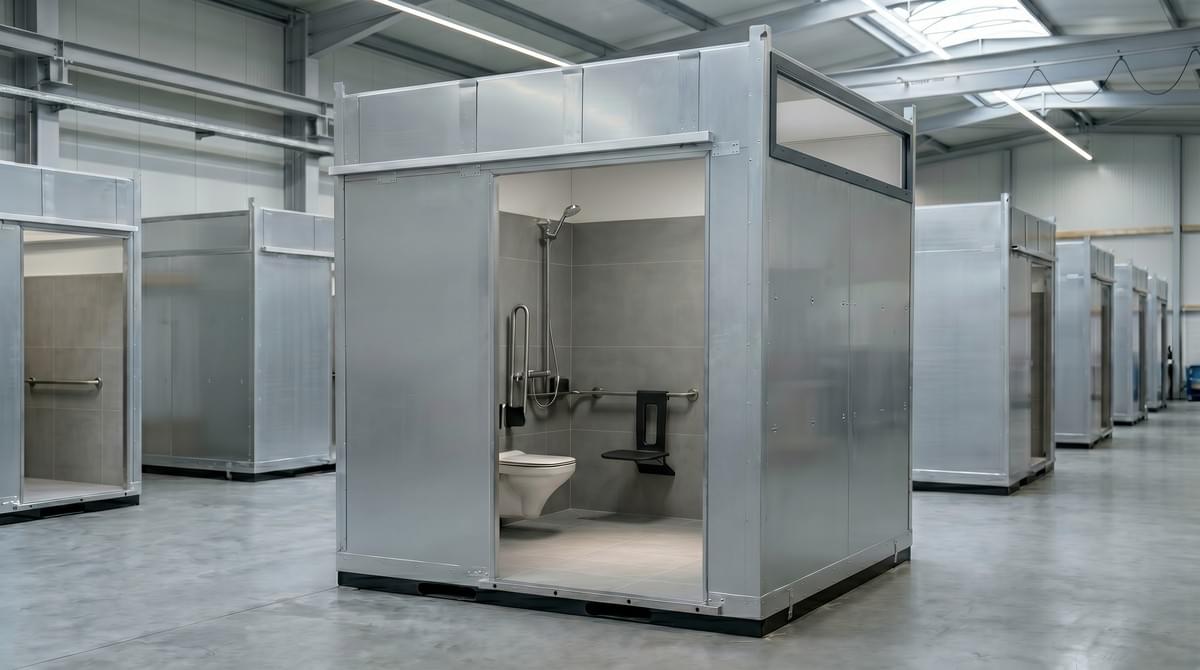
When visiting a hospital, nursing home, or healthcare facility, attention naturally falls on the reception areas, patient rooms, corridors, and medical equipment.The bathroom, however, often goes unnoticed.
Yet, it is arguably one of the most technically complex spaces within the building.
Within just a few square meters, structural elements, sanitary fittings, electrical systems, ventilation, wall and floor coverings, accessibility requirements, hygiene standards, maintenance access, and user safety must all coexist.
A bathroom occupies a limited footprint, but it concentrates a significant proportion of a building’s technical complexity.
The Observation
In a care facility, a bathroom is never a mere sanitary room.
It is used daily by individuals who may be elderly, mobility-impaired, or dependent on care. It undergoes constant heavy usage, is cleaned multiple times a day, and must maintain the same level of performance over several decades.
Added to these operational constraints are regulatory standards, technical specifications, and trade coordination across various disciplines.
The bathroom thus becomes one of the areas subject to the highest density of technical requirements.
The Analysis
For a long time, the bathroom was treated as an assembly of individual equipment items.
Design followed a sequential approach: structure, mechanical and electrical services, finishes, sanitary fixtures, and accessibility features.
Today, this approach demonstrates clear limitations.
Every additional stakeholder introduces an extra interface.
Experience shows that major issues occurring during the lifecycle of a building rarely originate from the equipment itself.
They arise at the interfaces:
- between floors and walls;
- between utility networks and the building structure;
- between different trades;
- between design and execution.
The higher the number of interfaces, the more critical their coordination becomes.Final quality therefore depends less on the individual performance of each component than on their ability to function together seamlessly.
The RIVERS Vision
Over the years, industry experience has led to an evolution in how professional bathrooms are designed.
A bathroom is no longer viewed as a succession of components to be assembled on-site, but as an integrated technical unit in which every element impacts the others.
This approach requires simultaneous consideration of the structure, utility networks, waterproofing, maintenance accessibility, universal design, and long-term operating conditions.
In short, the quality of a bathroom is established long before construction begins.
It is determined at the design stage.
This philosophy forms the foundation of current developments regarding modular three-dimensional bathrooms, a topic that will be detailed in an upcoming publication.
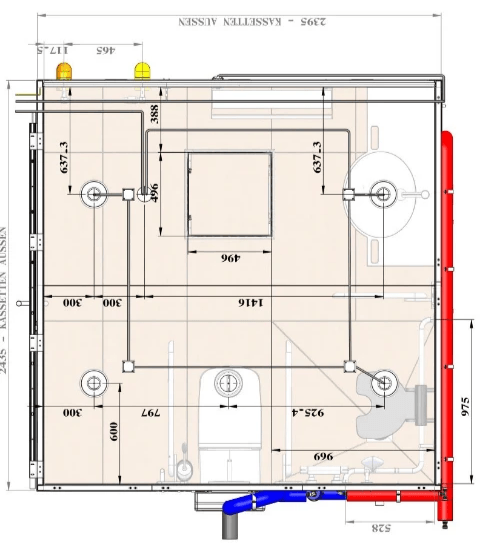
Reflections Beyond Prefabrication
Three-dimensional design should not be reduced to a manufacturing method alone.
Above all, it reflects a new way of thinking about the bathroom as a complete technical system, where every component is evaluated in relation to the whole.
This evolution addresses a growing reality in healthcare facilities: achieving sustainable quality improvements, simplifying maintenance, enhancing timeline predictability, and reducing risks associated with trade coordination.
Exploring this shift in design methodology is the core focus of this series of publications.
Conclusion
Healthcare facilities are evolving.
Their operational requirements are evolving accordingly.
In this context, the bathroom can no longer be considered a purely functional space.
It becomes a strategic asset whose design permanently influences the quality, safety, and operational efficiency of the building.
Understanding this evolution is the essential first step before examining the various technical solutions available today.
This is precisely the objective of the "Perspectives on the Professional Bathroom" series.
The RIVERS Conviction: Design first. Build second.
At RIVERS, the quality of a building is measured not solely by its execution, but primarily by the caliber of decisions made from the design phase onward. This conviction guides the approach and insights shared throughout this collection.